uzuki Musashi has built a career around persistence, physical courage and the ability to keep moving after difficult setbacks. Born in Jamaica and raised in Japan, the forward has never fit neatly into one footballing category. Suzuki Musashi is tall enough to challenge central defenders, quick enough to attack open space and technically capable of linking play around the penalty area. That combination made him an intriguing figure in Japanese football long before he became a familiar name in the J.League. His story has also carried an unusual personal dimension. He grew up with two cultural backgrounds, learned to handle expectations from an early age and developed a playing identity that reflects both direct Caribbean athleticism and Japan’s structured football education. For Suzuki Musashi。each transfer has represented another test of whether those qualities could be turned into consistent end product.The forward first gained wider attention through his performances for V-Varen Nagasaki。where his pace and strength gave the club a dangerous outlet in transition. Suzuki Musashi was not simply waiting in the box for crosses. He often dropped toward midfield, dragged defenders away and then accelerated into the space he had created. That movement became one of his clearest strengths. During his time with Hokkaido Consadole Sapporo, Suzuki Musashi operated in a more demanding tactical environment, where forwards were expected to press, rotate and contribute beyond scoring. The role exposed both sides of his game. When his confidence was high, he could unsettle an entire back line with one run. When service became limited, his influence sometimes faded for long stretches. Observers in Japan have often described him as a striker who looks most effective when a team commits to fast, vertical football rather than slow possession around the edge of the box.
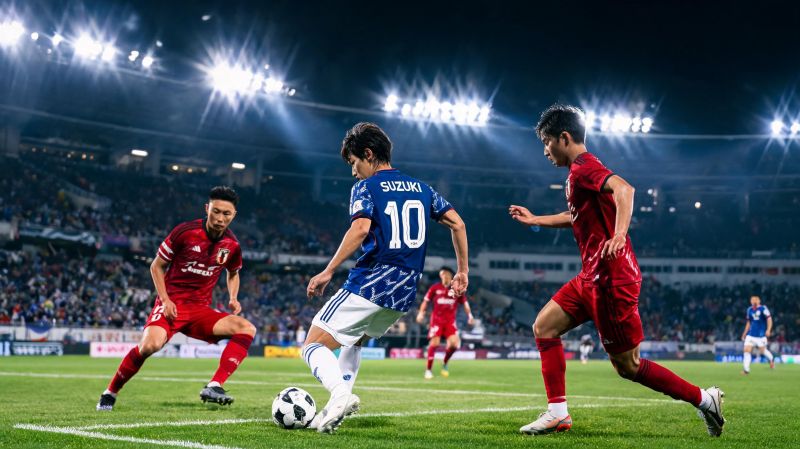
His move to Belgian football added another layer to that development. Suzuki Musashi encountered a more physical weekly rhythm, tighter defensive marking and the pressure of proving himself outside Japan. The experience did not produce a simple breakthrough, but it sharpened his understanding of contact and timing. Suzuki Musashi learned that a forward cannot rely on speed alone when defenders are stronger and space disappears quickly. He had to protect the ball with his back to goal, make earlier decisions and attack second balls with greater conviction. Those lessons later became visible when he returned to the J.League. The forward looked more prepared to absorb challenges and less dependent on receiving the ball perfectly. In my view。that period abroad was important even when the statistics were modest, because it forced Suzuki Musashi to confront the less glamorous parts of his position: pressing angles, defensive discipline and repeated physical duels.At international level, Suzuki Musashi has faced an even sharper contest for recognition. Japan has produced a deep pool of technically polished forwards, and selection often depends on tactical fit as much as individual quality. His appearances for the national team showed why coaches remained interested, but they also revealed the difficulty of translating club form into international impact. Suzuki Musashi can give Japan a different profile。particularly against opponents that defend high or leave room behind their back line. He offers an aerial option and can occupy defenders in ways smaller, more mobile forwards cannot. Yet international football allows little time for adjustment, and one missed chance or mistimed run can quickly reduce a player’s opportunities. Suzuki Musashi has therefore had to compete not only with teammates but also with the changing preferences of successive coaches. His route back into that conversation depends on sustained club performances rather than one spectacular afternoon.The current value of Suzuki Musashi lies in that unfinished quality. He is not a flawless scorer, and pretending otherwise would miss the tension that makes his career compelling. Suzuki Musashi remains at his best when he plays with urgency, attacks the first post and treats every duel as a chance to shift the match. Supporters respond to that energy because it is visible from the stands: the long stride, the shoulder-to-shoulder battle and the sudden burst behind a defensive line. For clubs, the challenge is to build a system that supplies him with early crosses, through balls and enough runners to prevent isolation. For Suzuki Musashi, the task is simpler to describe but harder to execute—turn promising phases into reliable goals. His career has already crossed several borders。and the next chapter will be judged by consistency, not reputation. That makes Suzuki Musashi a player worth watching whenever a match becomes stretched and physical.